
Summary
Sometimes, a large ovary may not be a bad thing. Ovaries go through size and appearance changes during the menstrual cycle, especially near ovulation. However, ovary size or the presence of cysts may also be associated with PCOS, endometriosis, fertility drugs, or other medical issues that may need to be checked by your health care provider.
What does a big ovary mean? The implications of a big ovary vary with how big the ovary is, what it looks like in an ultrasound scan, if you have symptoms, your age, when you are in your menstrual cycle, and what the underlying reason is. Some need observation, some need medications, and some need surgery.
Introduction
If you find out your ovary is enlarged on ultrasound, it can be alarming. You might be thinking, “what does enlarged ovary mean, can this affect my fertility or is it a serious health problem?”
The encouraging part is that the ovary size can fluctuate with the monthly cycle. The follicle, which eventually leads to ovulation or the release of an egg, enlarges at the time of ovulation and can be seen as an abnormal structure on an ultrasound. Some cysts are normal features of ovulation.
Long-standing or accompanied by severe symptoms, ovarian size should not be overlooked. It is not the size, but the reason for it. Your physician will weigh your personal risk factors, your symptoms, menstrual history, and ultrasound report before recommending treatment or observation.
What Can Cause an Enlarged Ovary?
Why might an ovary be enlarged? In some cases, enlarged ovary changes are short-term and harmless, but in others they need further investigation. The following are some of the reasons behind enlarged ovaries: normal ovulation, ovarian cysts, PCOS, endometriosis, fertility treatment, and, very rarely, an ovarian tumour.
Changes related to ovulation
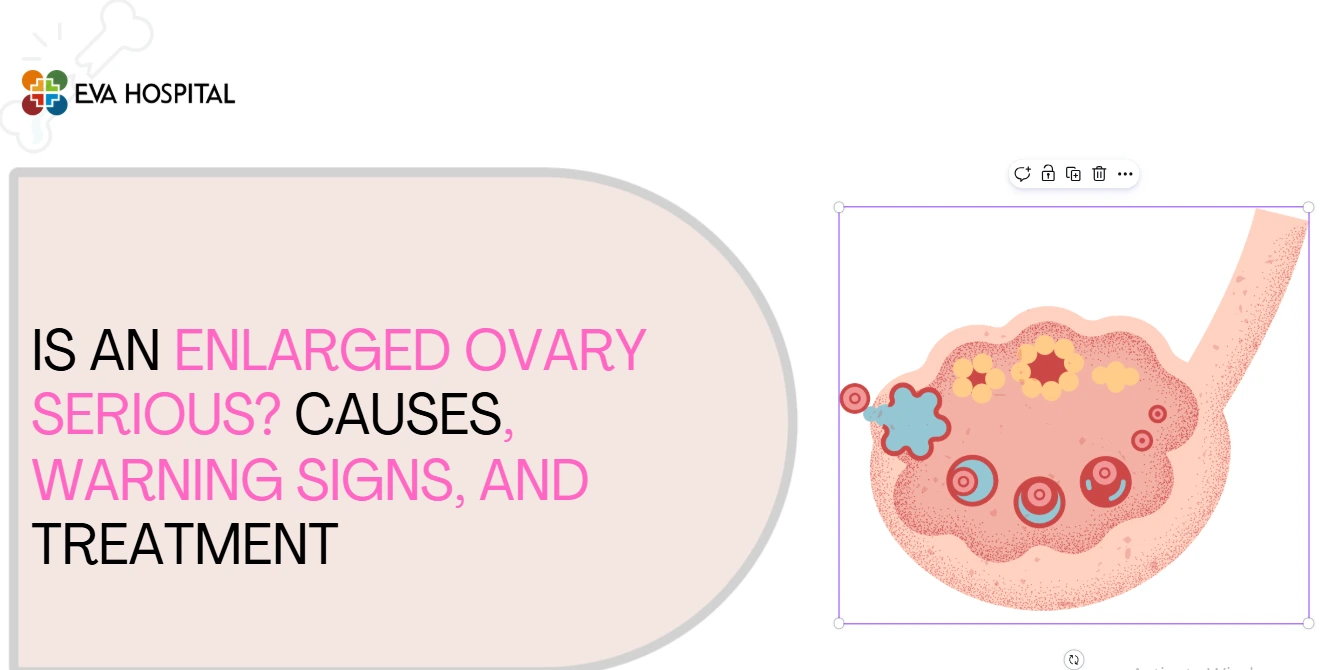
The ovaries are working all the time. When you are about to ovulate, a follicle that has an egg in it matures and develops. The follicle then turns into a body called the corpus luteum once the egg has been released.
These typical alterations may transiently influence the size and shape of the ovary. So, there can be a dissimilar ovarian measurement to a small extent; it does not necessarily mean it is a disease.
Ovarian cysts and other conditions
An ovarian cyst can cause an ovary to be enlarged. The majority of cysts are functional and decrease in size on their own; however, some grow or have effects such as pelvic pain or pressure, bloating, or a change in the pattern of bleeding.
Other conditions, such as endometriosis, can also cause the development of ovarian cysts, so-called endometriomas. PCOS results in many small follicles and may be associated with an increased ovarian volume.
What Does Ovary Size Tell You About Your Health?
The size of an ovary is only one component of an ultrasound. Doctors do not evaluate an ovary as being good or bad based on one measurement. It’s a combination of its structure, follicles, cysts, blood flow, and appearance.
Understanding normal ovarian measurements
Common searches related to right ovary normal size, right ovary size in mm, or ovary size in cc are as follows. But there is no one specific size that is suitable for all women.
The size of the ovary may also change with time, stage of the menstrual cycle, pregnancy, and fertility. The size of the right ovary also may slightly differ from that of the left ovary. The right ovary and left ovary may therefore have slightly different measurements without necessarily indicating a problem.
Equally, ovarian volume may be given in ml, mm, or cm. Your doctor is likely to view the entire ultrasound and not simply one reading. Terms such as right ovary measures, right ovary size in cc, right ovary volume, left ovary measures, and left ovary size in mm may appear in an ultrasound report.
Why ultrasound appearance matters
An ultrasound can reveal if the ovary has follicles, a simple cyst, a complex cyst, solid portions, or other abnormalities. The appearance of an ovarian finding can occasionally have more significance than size.
So, in the case you’ve read in your report that the ovary is enlarged/has a high volume, it is better to go through the whole report with a gynaecologist rather than trying to match the number you get online.
What Are the Symptoms of Ovarian Enlargement?
Some women have no symptoms at all, and the ovarian enlargement is found incidentally on ultrasound. Symptoms of ovarian enlargement, if they occur at all, depend on the cause and size of the ovarian change.
Common symptoms
Signs and Symptoms: Pressure or discomfort in the pelvic area or abdomen; Bloating; Feeling of heaviness in the lower abdomen; Pain during menstrual periods or abnormal bleeding; Pain during sex.
Other women may have bowel or bladder changes if a large ovarian cyst or mass exerts pressure on your organs.
Having symptoms doesn’t automatically signify that your condition is significant. If your symptoms persist, become more severe, or stop you from doing your usual activities, they will be concerned.
Sudden pain and other warning signs
Rapid, intense pelvic pain may be a medical emergency. Severe pain on one side of the pelvis with nausea and vomiting may be ovarian torsion.
Ovarian torsion is the twisting of the ovary and connecting tissues. The twisting can cut off the ovary’s blood supply. It is a medical emergency.
Do not ignore symptoms like severe swelling of the abdomen, loss of consciousness, heavy bleeding, continuous vomiting, and pain.
Can PCOS Cause Ovarian Enlargement?
PCOS is a common condition where the appearance of your ovaries can be affected. But larger ovaries do not necessarily mean you have PCOS.
Ovaries and multiple follicles
In PCOS, an ultrasound can show multiple small follicles or cysts in the ovary. Some people also have higher than normal ovarian volume. The ultrasound results are assessed along with one’s symptoms, the pattern of menstruation, and signs of excess androgen.
Hence, the size and appearance alone are not to be used as criteria for diagnosis.
Other signs of PCOS
Individuals with PCOS might have infrequent or no periods, trouble ovulating, acne, darker skin or hair, or extra hair on your face or body.
A gynaecologist can help you decide if additional tests are needed if you have some of these signs and symptoms and an abnormal ultrasound.
Can a Bicornuate Uterus Cause an Enlarged Ovary?
What is a bicornuate uterus? A bicornuate uterus is a congenital abnormality of the shape of the uterus. The top of the uterus is divided into two.
Understanding the difference
The uterus and ovaries are independent organs. As a result, having a bicornuate uterus is not a direct cause of swollen ovaries.
If both results are seen in the same ultrasound report, they are usually reported separately. Your doctor will evaluate the shape of the uterus and the size and appearance of each ovary.
When further evaluation helps
For a woman with an abnormality of the ovaries and a bicornuate uterus, your doctor will take into account your symptoms, your childbearing goals, and your period history, as well as all the imaging results, to guide you on any further evaluation.
When Should You See a Doctor About an Enlarged Ovary?
A non-symptomatic, mildly enlarged ovary may not require treatment. Treatment may not be necessary in some cases. Your doctor may prefer to observe the ovary with another ultrasound scan.
But, persistent symptoms or the ultrasound appearance should be given an appropriate workup.
Symptoms that need attention
Consult your doctor if symptoms persist in the pelvic area, if you experience a ballooning feeling in the abdomen, bleeding that is not normal in the vagina, headache during intercourse, change in weight, or symptoms keep recurring.
Visit the doctor promptly if you develop severe pelvic pain and nausea or vomiting, because such illnesses as ovarian torsion may be life-threatening.
Obtaining the proper assessment
Your doctor will inquire about your period, ability to become pregnant, treatments you have taken, fertility and past ovarian cysts, and now symptoms.
Evaluation may include a pelvic or transvaginal ultrasound, blood tests, a pregnancy test, or imaging if necessary, based on the results of initial tests.
Depending on the findings, if you feel you need expert advice about an ovarian finding or any other concerns regarding your period or reproduction, you could opt for a gynaecology appointment.
What Is the Treatment for an Enlarged Ovary?
Treatment varies according to the cause. Unfortunately, there isn’t one method that will be applicable to all women.
Monitoring and medications
Very small functional cysts can go away spontaneously. If your doctor feels that the ovarian change is probably going to go away on its own, they may suggest observation and a repeat ultrasound after a reasonable interval.
Pain-reducing medications can be prescribed if necessary. Endometriosis, PCOS, and other hormonal issues may require treatment depending on the symptoms and fertility plans of the patient.
Surgery and urgent treatment
More extensive evaluation is necessary if you have a larger, persistent, complex, or symptomatic ovarian mass. Surgery might be suggested to remove a cyst or other growth.
Ovarian Torsion is unique in that it is a surgical emergency and the ovary may need to be “untwisted” to reestablish blood flow.
Another area of study has been the use of ovarian volume and other measurements of the ovary to help provide an understanding of one’s potential for fertility, and this is the same reason we look at ultrasound measurements for the person and not the numbers alone. Read more about ovarian volume and measurements of the ovary in reproductive years.
Can an Enlarged Ovary Affect Pregnancy?
Having an ovary size change does not necessarily make conception more challenging. How it will affect fertility is largely determined by the cause of the increased size.
Temporary ovarian changes
Normal ovulation and most functional cysts don’t usually affect fertility in the long term. When the underlying change has gone, the ovary can look normal again.
But some conditions, like endometriosis and PCOS, may cause abnormal ovulation, and if they affect fertility, they may need to be managed accordingly.
Pregnancy-induced ovarian enlargement
Ovarian cysts may be incidentally found during pregnancy. Most are not treated and are observed over time, especially when they have a benign appearance.
Any ovarian mass during pregnancy is monitored or treated based on its size, appearance, symptoms, and the stage of pregnancy.
FAQs
Is ovarian enlargement always serious?
No. Ovaries are capable of becoming enlarged, even briefly, with ovulation or functional cysts. Still, if your ovaries seem enlarged or you experience symptoms, consult your doctor.
What are the symptoms?
No symptoms are experienced by some women. Others may have pain in the pelvis, bloating, abdominal pressure, changes in their monthly period, or pain during sex.
Does PCOS increase the size of the ovaries?
An association between PCOS and enlarged ovaries and numerous small follicles. But enlarged ovaries cannot be used solely for the diagnosis of PCOS.
Is an enlarged ovary on one side bad?
Not necessarily. It may be that the ovary is slightly smaller or larger than the other. The significance of this (even though one ovary is a bit smaller) depends on the reason for the scan, its ultrasound appearance, its presentation, and whether this is a state that is present consistently.
Can an ovarian cyst cause enlargement?
Q: Does an ovarian cyst enlarge the ovary? A: Yes. The presence of an ovarian cyst can enlarge or change the shape of the ovary, though many functional cysts resolve on their own and some may need observation or treatment.
When is ovarian enlargement an emergency?
Intense Pelvic Pain, Vomiting or Nausea: Possible Ovarian Torsion. Sudden, intense pain in the pelvis along with nausea or vomiting should be treated immediately. This may be due to ovarian torsion or another condition.
What if the ultrasound diagnosis says I have an enlarged ovary?
Don’t panic just based on the measurements. Take your entire ultrasound report to your gynaecologist who will assess the size, the structure of the ovaries, your symptoms and cycle and decide if treatment or monitoring is required.