
IVF & Fertility Care Hospital in Punjab- Eva Hospital
Your consultation starts with an assessment of both partners and a discussion of the treatment suited to your circumstances. IVF is one option—we help you understand whether it is the right next step
- NABH accredited
- Assessment of both partners
- In-house embryology laboratory

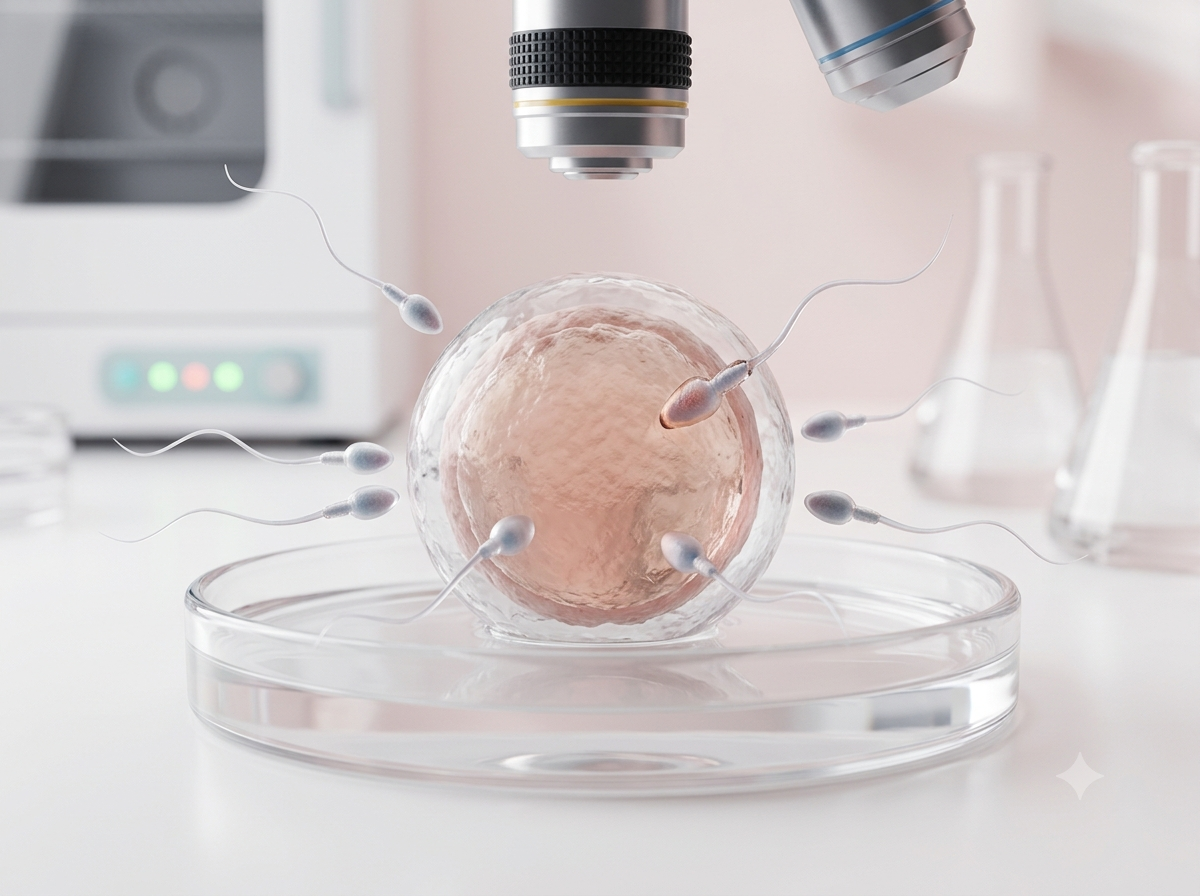
The treatment, explained
What Is IVF?
In vitro fertilisation (IVF) is a treatment in which eggs are collected from the ovaries and fertilised with sperm in a laboratory. The resulting embryos are monitored, and a suitable embryo may be transferred to the uterus.
With ICSI—a variation of IVF—a single sperm is injected directly into each egg. ICSI is not required for every couple; it is usually recommended for specific sperm-related or laboratory reasons.
Not every couple needs IVF. A careful assessment comes first.
Disclaimer: Above Image are AI-generated for illustrative purposes only.
Who May Need IVF Treatment?
Unexplained infertility
Reduced ovarian reserve
Age-related decline in fertility
Endometriosis
Previous unsuccessful fertility treatment
Male-factor infertility (sperm count or motility)
Blocked or damaged fallopian tubes
Repeated unsuccessful IUI cycles
Ovulation disorders not responding to other treatment
Certain combinations of male and female fertility factors
Situations where IVF with ICSI is considered appropriate
Your IVF Journey
Assessment
Fertility work-up for both partners
Stimulation
Medication to develop multiple eggs
Monitoring
Ultrasound & hormone tracking
Egg Retrieval
Eggs collected under sedation
Fertilisation
IVF or ICSI in the laboratory
Embryo Culture
Embryos observed as they develop
Embryo Transfer
Selected embryo placed in the uterus
Pregnancy Test
Blood test confirms the outcome
The IVF Process: Step by Step
Understanding what happens during IVF can make the treatment considerably less intimidating. Although protocols vary between patients, an IVF cycle generally involves the following stages.
Fertility Assessment and Planning
Treatment begins with a detailed consultation and review of the couple's reproductive and medical history. The female partner may undergo assessment of ovarian reserve, hormonal investigations and pelvic ultrasound, while semen analysis and other investigations may be advised for the male partner. These findings help determine whether IVF is appropriate and allow the stimulation protocol to be individualized.
Ovarian Stimulation
During a natural menstrual cycle, the ovaries usually develop a single dominant egg. During IVF, fertility medications are used to stimulate the ovaries so that several follicles may develop simultaneously. The dose and combination of medication are selected according to factors such as age, ovarian reserve and previous response to fertility treatment.
Monitoring Follicular Development
During stimulation, ultrasound examinations and, where required, blood tests are performed to monitor the developing follicles. Medication doses may be adjusted according to the ovarian response. Once the follicles have reached an appropriate stage of development, a trigger injection is given to prepare the eggs for retrieval.
Egg Retrieval
Egg retrieval is scheduled at a carefully determined interval following the trigger injection. Under ultrasound guidance, the mature follicles are accessed and the follicular fluid containing the eggs is collected. Appropriate anaesthesia or sedation is used to make the procedure comfortable. The collected eggs are then transferred to the embryology laboratory.
Sperm Preparation
A semen sample is generally obtained on the day of egg retrieval and processed in the laboratory to select suitable sperm for fertilization. In situations involving significant male-factor infertility, additional evaluation or sperm-retrieval techniques may sometimes be required.
Fertilization — IVF or ICSI
With conventional IVF, prepared sperm and eggs are brought together in the laboratory to allow fertilization to occur. When ICSI is indicated, an embryologist introduces a single selected sperm directly into an egg. ICSI is particularly useful in certain cases of male-factor infertility and in other selected clinical situations.
Embryo Development
After fertilization, embryos are carefully observed as they develop in the laboratory. Depending upon embryo development and the individual treatment plan, embryo transfer may be performed at an appropriate developmental stage. In suitable circumstances, embryos may be cultured to the blastocyst stage before transfer or freezing.
Embryo Transfer
A selected embryo is transferred through the cervix into the uterus using a fine catheter. The procedure is generally straightforward and usually does not require anaesthesia. The number of embryos transferred should be decided individually, taking into account the patient's age, embryo characteristics, reproductive history and the risks associated with multiple pregnancy.
Transferring more embryos is not simply a way of guaranteeing greater success. Multiple pregnancy is an important preventable risk of fertility treatment, which is why embryo-transfer decisions need to balance the chance of pregnancy with maternal and fetal safety.
Embryo Freezing
If additional suitable embryos are available, they may be frozen by vitrification for possible future use. Frozen embryos may subsequently be used in a frozen embryo transfer cycle without repeating ovarian stimulation and egg retrieval.
After Embryo Transfer
Medication is generally continued to support the uterine lining after embryo transfer. A pregnancy test is performed at the appropriate interval advised by the fertility specialist. If positive, further evaluation is arranged to confirm the location and progress of the pregnancy.
IVF or ICSI: What Is the Difference?
Conventional IVF
ICSI
Embryo Transfer & Embryo Freezing
Embryo Transfer
Embryo Freezing (Vitrification)
What Determines IVF Success?
Woman's age
Ovarian reserve
Number and quality of eggs obtained
Sperm quality
Embryo development
Uterine and endometrial factors
Individual response to ovarian stimulation
Cause and duration of infertility
Previous pregnancies and fertility treatments
Associated medical conditions
Is IVF Safe?
IVF is generally considered safe, but like any medical treatment it is not completely without risk. Potential risks include ovarian hyperstimulation syndrome (OHSS), complications associated with egg retrieval, ectopic pregnancy and multiple pregnancy when more than one embryo implants. Serious complications are uncommon, but patients should understand the potential risks before beginning treatment.
Careful ovarian stimulation, appropriate monitoring and thoughtful embryo-transfer planning are therefore important components of fertility treatment.
Fertility Treatments at Eva Hospital
ICSI – Intracytoplasmic Sperm Injection
IUI – Intrauterine Insemination
Female Infertility Evaluation & Treatment
Male Infertility Evaluation & Treatment
Facilities and Services
Individualized Fertility Treatment
Complete IVF Treatment Pathway
IVF & ICSI
Embryo Freezing
Clear Counselling
Fertility Care in Punjab
Our Doctor
Details of registered medical practitioners at Eva Hospital, Ludhiana, provided for patient information.
Dr. Shivani Bhutani
Obstetrician, Gynaecologist & IVF Specialist
- Qualifications
- MBBS, M.S. (Obstetrics & Gynaecology)
- Speciality
- Obstetrics and Gynaecology & IVF Specialist
- Registration Status
- Registered
- Registration No. (PMC)
- 40141
- Registered With
- Punjab Medical Council (PMC)
- OPD Days
- Monday to Saturday
- Morning Timings
- 10:00 AM to 2:00 PM
- Evening Timings
- 6:00 PM to 8:00 PM
Registration can be verified on the NMC website.
Frequently Asked Questions
As a general guide, consider an assessment:
- After 12 months of trying to conceive if the woman is under 35
- After 6 months of trying if she is 35 or older
- Sooner if there are known concerns—irregular or absent periods, known endometriosis, previous pelvic surgery, or a known sperm problem
- Over 40, a more immediate assessment may be appropriate
These are guides for when to get assessed—they do not mean IVF is automatically needed.
Yes. A woman’s fertility and the chance of success with IVF decline with age, particularly after 35 and more noticeably after 40. If you are in these age groups and are having difficulty conceiving, it is advisable to seek a fertility assessment promptly rather than waiting.
Most people find the injections manageable. Egg retrieval is done under anaesthesia/sedation, and embryo transfer usually feels similar to a routine pelvic examination.
A positive test is an encouraging early milestone, but it does not confirm a live birth. Early scans over the following weeks confirm whether the pregnancy is continuing as expected.
How many embryos are transferred?
What is ICSI?
Can embryos be frozen?
What happens if the first IVF cycle is unsuccessful?
Should both partners attend the first consultation?
Begin With a Fertility Consultation
Leave your name and number. You don’t need to have decided on IVF—the first step is simply a conversation and an assessment.
What happens next
- A member of our [fertility coordination team] calls you within [X working hours].
- We understand your concern and suggest a suitable appointment time.
- Your appointment is confirmed by [SMS / WhatsApp].
Prefer to talk now?
This page is for general information and does not replace a consultation with a qualified doctor. Treatment recommendations and outcomes vary between individuals. Eva Hospital, [full address], Ludhiana, Punjab.
The number is decided individually, based on the woman’s age, embryo quality and previous treatment history. Transferring a single embryo, where clinically appropriate, helps reduce the risk of multiple pregnancy.
ICSI (intracytoplasmic sperm injection) is a method of fertilisation in which an embryologist injects a single sperm directly into an egg. It may be recommended for low sperm count, poor sperm movement, previous fertilisation difficulty or another clinical reason. It is not required for every IVF cycle.
Yes. Suitable embryos that are not transferred in the fresh cycle can be frozen by vitrification and used later in a frozen embryo transfer cycle, without repeating ovarian stimulation and egg retrieval.
It is generally helpful, because both partners contribute to fertility. The doctor can then plan the evaluation of both partners together.
Ideally, yes. Fertility assessment involves both partners, and many decisions are easier to make together.
There is no universal age at which every woman should undergo IVF. However, female fertility and IVF outcomes are strongly influenced by age, so delaying fertility assessment can be important, particularly as reproductive age advances. Individual assessment is preferable to using age alone to decide treatment.