
Summary
A sudden attack of gout can be dramatic. A joint that felt completely normal the previous evening may become intensely painful, swollen, red and warm within a few hours. Because the inflammation can be so severe, patients sometimes wonder whether gout is an autoimmune disease.
The short answer is no.
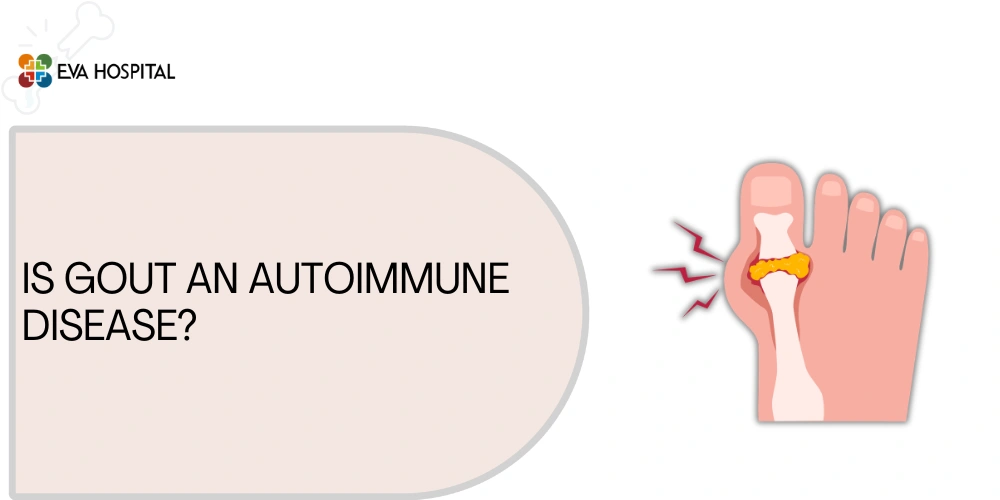
Dr Tanveer Bhutani working as ortho specialist in ludhiana at Eva Hopsital shares that Gout is an inflammatory form of arthritis, but it is not considered a classic autoimmune disease such as rheumatoid arthritis. In gout, inflammation occurs because crystals of urate collect in and around a joint and trigger a powerful response from the body’s immune system.
Understanding this difference is useful because although gout and autoimmune arthritis can sometimes look similar, their causes and treatment are quite different.
What Actually Causes Gout?
Urate is produced naturally when the body breaks down substances called purines. Purines are present in our own cells and are also found in certain foods.
Normally, urate is dissolved in the blood and removed mainly through the kidneys. Problems arise when the body produces more urate than it can eliminate, or when the kidneys are unable to remove enough of it.
Over time, the urate level in the body may rise. In some people, this leads to the formation of tiny needle-shaped monosodium urate crystals.
These crystals can collect in and around joints.
When the immune system recognises these crystals, it reacts strongly. The result is the intense inflammation that produces the familiar symptoms of a gout attack—pain, swelling, redness, warmth and marked tenderness.
If the Immune System Is Involved, Why Isn’t Gout an Autoimmune Disease?
This is where the distinction becomes important.
In an autoimmune disease, the immune system mistakenly attacks the body’s own healthy tissues.
Rheumatoid arthritis is a good example. The immune system becomes abnormally directed against structures within the joints and causes persistent inflammation.
Gout is different.
The immune system is not attacking normal joint tissue because it has mistaken it for something harmful. Instead, it is responding to urate crystals that have accumulated inside or around the joint.
For this reason, gout is better described as crystal-induced inflammatory arthritis rather than an autoimmune arthritis.
You may occasionally hear gout discussed in relation to autoinflammatory conditions. This refers to the way the body’s innate immune system reacts to urate crystals. For most patients, however, the important point is simpler: gout involves the immune system, but it is not the same disease process as rheumatoid arthritis or other classic autoimmune conditions.
Which Joints Does Gout Affect?
The joint at the base of the big toe is the classic site for gout and is one of the most commonly affected areas.
However, gout is by no means limited to the big toe.
It can also affect the:
- Ankle
- Foot
- Knee
- Wrist
- Fingers
- Elbow
- Other joints
In the early stages, gout frequently affects a single joint during an attack. In people who have had the condition for longer, several joints may eventually become involved.
What Does a Gout Attack Feel Like?
A gout attack often begins very suddenly.
Many patients describe going to bed feeling normal and waking during the night with severe pain.
The affected joint may become:
- Extremely painful
- Swollen
- Red
- Warm
- Very tender to touch
Even light contact from clothing or a bedsheet can sometimes feel uncomfortable.
Walking may become difficult when the big toe, foot, ankle or knee is involved.
The first attack may settle, and the patient may remain symptom-free for weeks, months or even longer. Repeated untreated attacks, however, may gradually become more frequent or involve additional joints.
Does High Uric Acid Always Mean Gout?
No.
This is an important point because raised uric acid and gout are not exactly the same thing.
Many people have an elevated urate level in their blood but never develop gout. Conversely, the diagnosis of gout should not be made purely because a blood test shows an elevated uric acid level.
Doctors therefore consider the entire clinical picture—the pattern of pain, the joint involved, examination findings, previous attacks and, when necessary, additional investigations.
How Is Gout Diagnosed?
In many cases, the history and examination are strongly suggestive of gout.
A blood test may be performed to measure the uric acid level, but the result has to be interpreted carefully.
When there is doubt about the diagnosis, fluid can sometimes be removed from the swollen joint with a needle. Examination of this fluid for urate crystals can help confirm gout.
Joint fluid analysis can be particularly valuable when the first attack is unusual, when several possible diagnoses exist or when infection needs to be ruled out.
Ultrasound and specialised CT imaging may also occasionally demonstrate urate crystal deposits.
A Hot, Swollen Joint Is Not Always Gout
This deserves particular emphasis.
A very painful, red and swollen joint should not automatically be labelled as gout simply because the patient has previously had high uric acid.
Several other conditions can produce a similar appearance, including:
- Joint infection
- Injury
- Rheumatoid arthritis
- Osteoarthritis with acute inflammation
- Other crystal-related arthritis
A joint infection can sometimes look remarkably similar to an attack of gout and may require urgent treatment.
Someone experiencing a first episode of severe joint swelling—particularly when accompanied by fever, chills or feeling generally unwell—should therefore seek medical assessment rather than simply treating it as gout at home.
Gout and Rheumatoid Arthritis: What Is the Difference?
The two conditions can overlap in their symptoms, but their underlying mechanisms are different.
Gout is caused by the deposition of urate crystals in and around joints.
Rheumatoid arthritis is an autoimmune disease in which the immune system attacks joint tissues.
Gout commonly presents as sudden attacks of very severe pain, often beginning in one joint.
Rheumatoid arthritis more commonly causes persistent inflammation affecting several joints and often has a more symmetrical pattern.
There can, however, be exceptions to both patterns.
It is also possible for the same patient to have rheumatoid arthritis and gout. Therefore, a new swollen joint in someone who already has arthritis should not automatically be assumed to be part of their existing condition.
Can Gout Damage the Joint?
Yes, particularly when it remains uncontrolled for a long period.
Repeated deposition of urate crystals can eventually lead to collections known as tophi. These may develop around joints and other tissues.
Long-standing gout can lead to:
- Repeated painful attacks
- Chronic joint inflammation
- Joint stiffness
- Bone and cartilage damage
- Tophi around joints and soft tissues
This is one reason why patients who experience recurrent gout attacks should not think of treatment as simply taking a painkiller whenever another attack appears.
Preventing further crystal accumulation is an important part of long-term care.
How Is an Acute Gout Attack Treated?
The first aim during an acute attack is to bring the inflammation and pain under control.
Depending upon the patient’s age, kidney function, other medical conditions and medications, treatment may include:
- Anti-inflammatory medication
- Colchicine
- Corticosteroids
The choice of treatment is individual. A medicine that is appropriate for one patient may not necessarily be suitable for another.
This is particularly important in patients with kidney disease, stomach problems, cardiovascular disease or those taking blood-thinning medications.
Preventing Future Gout Attacks
Treatment does not end once the pain settles.
Patients who have repeated attacks, tophi or other complications may require long-term treatment aimed at reducing the amount of urate in the body.
Lowering urate helps prevent new crystals from forming and gradually reduces the crystal burden that has accumulated over time.
This can significantly reduce the likelihood of future attacks.
Lifestyle measures can also help, particularly when they address factors that contribute to raised uric acid.
These may include:
- Maintaining a healthy weight
- Reducing excessive alcohol intake
- Avoiding frequent sugar-sweetened beverages
- Reviewing the diet where appropriate
- Managing associated medical conditions
- Reviewing medications that may influence uric acid when medically appropriate
Diet is certainly relevant, but gout should not simply be regarded as a disease caused by eating the wrong food.
Genetics, kidney function, body weight, other illnesses and medications can all play a role.
For patients with recurrent or established gout, lifestyle changes alone may not always be enough.
Who Is More Likely to Develop Gout?
A number of factors can increase the likelihood of developing gout.
These include:
- Family history of gout
- Increasing age
- Kidney disease
- Obesity
- Excessive alcohol intake
- Certain medications
- Diets containing large amounts of some purine-rich foods
- Persistently elevated uric acid levels
Having one or more of these factors does not mean that a person will definitely develop gout.
Similarly, someone can develop gout without having every traditional risk factor.
When Should You See a Doctor?
Medical assessment is advisable if you develop a sudden episode of severe joint pain, particularly when the joint becomes swollen, hot or red.
You should seek assessment especially if:
- This is your first such attack
- The diagnosis of gout has never been confirmed
- Several joints are involved
- Attacks are becoming more frequent
- You have developed lumps that could represent tophi
- The pain is not settling as expected
- You have fever or feel generally unwell
- The joint remains painful between attacks
The important thing is to establish the correct diagnosis rather than assuming that every painful joint is caused by uric acid.
The Bottom Line
Gout is not a classic autoimmune disease.
It is a form of inflammatory arthritis caused by the deposition of urate crystals in and around joints. These crystals trigger a strong immune response, which explains why a gout attack can become so intensely painful and swollen.
The good news is that gout is a very treatable condition.
Managing an acute attack is only one part of treatment. In patients with recurrent disease, identifying the cause, controlling urate levels and preventing further crystal deposition can reduce attacks and help protect the joints over the long term.
A painful or swollen joint, however, should always be diagnosed properly—particularly during a first episode—because gout is only one of several conditions that can present in this way.
Frequently Asked Questions
Is gout an autoimmune disease?
No. Gout is an inflammatory arthritis caused by deposits of monosodium urate crystals. The immune system reacts to these crystals, but it is not attacking normal joint tissue in the way it does in a classic autoimmune disease.
Is gout the same as rheumatoid arthritis?
No. Rheumatoid arthritis is an autoimmune disease, while gout is caused by urate crystal deposition. Although both can cause painful and swollen joints, their underlying causes are different.
Does high uric acid always mean that I have gout?
No. Some people have elevated uric acid levels for years without ever developing a gout attack. The diagnosis should be based on the overall clinical picture rather than a single blood test.
Can gout affect the knee or ankle?
Yes. Although the big toe is the best-known site, gout frequently affects the ankle, foot and knee and may involve several other joints.
Can gout permanently damage a joint?
It can. Repeated or poorly controlled gout can cause chronic inflammation, tophi and damage to the joint and surrounding tissues.
Can gout and rheumatoid arthritis occur together?
Yes. Having one condition does not prevent someone from developing the other. A new or unusual joint swelling therefore deserves proper assessment rather than automatically being attributed to an existing diagnosis.
Is gout treatable?
Yes. Acute attacks can usually be controlled with appropriate medication, and long-term treatment can reduce urate levels and help prevent recurrent attacks and joint damage.
Is changing my diet enough to control gout?
For some people with mild disease, lifestyle changes can be helpful. Patients with recurrent gout, tophi or more established disease may also require long-term urate-lowering treatment. Diet should be considered one part of gout management rather than the entire treatment.