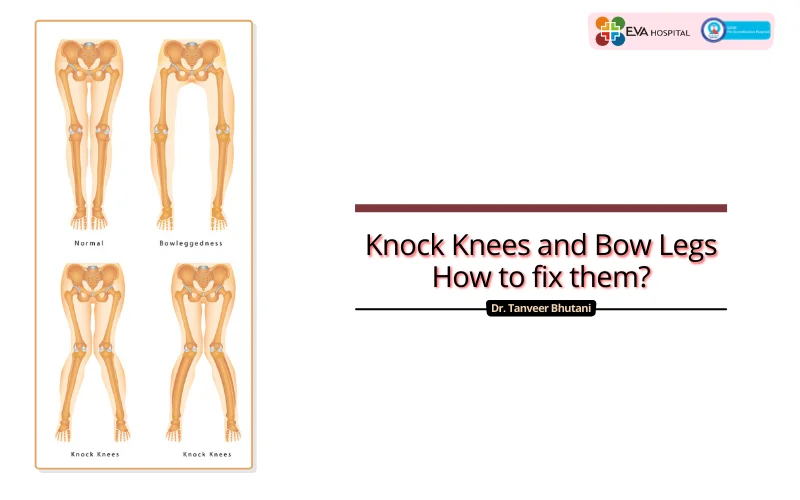
Knock knees or bow legs are both common conditions where the knees and ankles are not in alignment with each other.
A slight angle of bowing or knocking is considered normal. However, if your child or an adult has severe bow legs, you must have an orthopedic doctor in Punjab examine him or her. Hello, Today me Dr Tanveer Bhutani a well known bone specialist in Ludhiana will guide you about Knock Knees and Bow Legs so keep reading.
What are Bow Legs?
Also called Genu varum, it is a condition where the knees do not join and curve out. The joints are spaced apart, while the ankles are close together. Babies are usually born with physiologic bow legs that tend to straighten by the age of 2 years.
What are Knock Knees?
Knock knees or Genu valgum is a condition where the feet do not join when standing with the legs joined together. The knees tilt towards each other, and the legs stay apart. It usually impacts both legs, but it may happen that only one knee is knocking the other. It affects people of all ages.
Bow legs- Causes, Symptoms, and Treatment
Causes
Bow legs in infants correct themselves as they grow. However, in rare cases, they may not, indicating a critical medical situation. The following are the plausible causes:-
- Rickets– An abnormal condition of the bones that rises due to a lack of vitamin D. It causes the leg bones to grow in curvature rather than straight. Rickets may also be hereditary.
- Blount disease– A bone growth deformity that affects the leg bones.
- Knee Injury– Injuries, tumors, or infections around the knees at an early age also may cause bow legs.
- Overweight – Obesity and too much weight gain.
- Walking Early– The child started walking at a very early age
When should you see a doctor?
Slight bow legs are not a concern as such. But, you must consult a bone specialist (orthopedic surgeon) in the following conditions.
- The legs are not straightening up with age.
- The curves are asymmetric, i.e, both legs are curved at different angles.
- The kid is experiencing pain, has a limp, trouble running, and/or weakness in the legs.
Treatment for Bow Legs
The orthopedic surgeon would examine the legs and confirm the cause through an expert diagnosis. The treatment would depend on that.
- Physiological bow legs are normal and require no treatment.
- A child with Rickets is treated by supplementing vitamin D in the diet.
- Blount’s diseased bow legs can be cured with surgery or braces.
How to Fix Bow Legs Naturally
Genu varum Bow legs are the result of knee maintaining their apartness in an upright position. Proper exercises and lifestyle change can improve mild cases. Knowing how to fix bow legs early can help improve posture, reduce knee stress, and prevent long-term joint issues. Right muscle strengthening and stretching is important in slowly changing alignment.
Specific Muscle Strengthening.
One of the most effective ways to address bow legs is through bow legs correction exercise that strengthens the quadriceps, hamstrings, glutes, and hip muscles. Leg lifts, squats, and side-lying leg lifts are exercises, which may help with alignment of the legs with time. Well-formed and consistent results are long-lasting necessities.
Supplementary Lifestyle Alterations.
Besides exercises, supportive footwear, being of normal weight and proper walking position can be used as a complement to correction exercises. In extreme situations, appointment to orthopedic specialist is recommended to help establish the need to correct bow legs by braces or surgery.
Knock Knees- Causes, Symptoms, and Treatment
Causes
Genu valgum is a condition where the knees are wrongly aligned and ‘knock’ against each other. It can be acquired at any age. If left untreated, it can cause knee pain and deformity, which worsens over time.
It is usually developed when the infant is learning to balance and walk. If the condition persists even after the age of, it is a knock knees syndrome.
Various known causes are:
- Injury- a physical impact de-aligns the joint
- Arthritis – degeneration of bone or joint
- Osteomyelitis – inflammation of leg bones
- Kidney failure- renal function failure
- Rickets- vitamin D deficiency
- Genetic conditions- acquired through heredity
- Fractures that are malformed at the union
- Bone tumors- benign tumors near the joints
- Obesity – excess weight-bearing by the legs
When to see the doctor?
When a young child has bow legs, it becomes apparent mostly around the age of three. A slight angle is considered normal, which settles around 5-9 degrees by the age of seven.
A larger angle that persists beyond that, with the following symptoms, mandates consultation with an orthopedic surgeon.
- Visible deformity in a kid under the age of two years.
- Knocking in kids that keeps deteriorating with age instead of correcting.
- Pain in the hips or knees.
- Pain in the ankle or foot.
- Difficulty in walking or running.
- Stiff joints with reduced range of motion.
- Progressing knee-joint arthritis
Adult patients with long-acquired Genu valgum experience instability and degeneration of the joint.
Treatment for Knock Knees
An orthopedic surgeon will examine & diagnose the extent of the condition. Dr. Tanveer Bhutani, a bone specialist at Eva Ortho Centre, says, “Preliminary examination evaluates the physical condition of the legs and the gait.
We include X-ray alignment tests and radio imaging of the entire hip and ankle region.” The precise location and the axis of the deformity sum up the diagnosis.
For severe cases( large angle), knee realignment is the answer. Surgery is the best way to correct knocking. Braces and other devices do not show satisfactory results. Eva Orthopedic Center has enormous expertise in managing all aspects of knock knees.
For growing children, knee alignment can be surgically altered too, with minimally invasive surgery. However, the procedure is usually postponed till the time they are 10 years old.
If there are any other underlying causes, such as infection, tumor, or bone disease, they are addressed medically first.
Understanding and Managing Knock Knees
ACL surgery is a widely practiced surgery to repair knee, following sports injuries or accidents. The recovery after surgeries should be paid close attention to swelling, pain control, and rehabilitation. Swelling after ACL surgery is one of the most frequent problems that patients have since it is natural to have as a response to surgical trauma. The swelling usually reaches its highest point within the first days and could be controlled by means of elevation, ice-packs, and prescribed anti-inflammatory drugs.
Timely after-surgery treatment helps speed up the healing process, minimizes pain, and avoids chronic conditions like stiffness or low mobility. Given that patients undergoing developed rehabilitation initiatives tend to report increased range of movement and strength in a few months, this helps in easier re-entry to regular life activities and sports.
Corrective Approaches and Knock Knees Cure Exercise
The question on many patients is is ACL surgery painful, and it is possible to state that in spite of the pain level which is different, modern surgery and medications allow overcoming it. The most common period is the initial days following the surgery, which are characterized by the maximum pains, which then slowly fade away in the coming weeks. Physicians usually prescribe a mixture of painkillers, anti-inflammatory drugs, and ice to help in managing pain. Early mobilization by use of physiotherapy under supervision also assists in reducing stiffness and promotes proper healing.
The second issue that is commonly expressed is when can I run after ACL surgery. Light jogging or treadmill walking can be initiated at 3 to 4 months after surgery when the patient has improved healing and the knee is stable enough, and this depends on the progress of healing. The beginning of the planned exercise program by the physiotherapist results in the knee being strengthened and flexible, which minimises the chances of re-injury. Failure to follow these instructions may result in the chronic pain in the knee, slow recovery, or complication of ACL surgery.
Surgical and Non-Surgical Solutions: Can Knock Knees Be Corrected?
Sleep is necessitated by the healing process, and most patients may ask themselves, how to sleep after ACL surgery. The correct sleeping posture will assist in minimizing swelling and also offer comfort in the healing process. The pressure on the joint in the back stress position can be eliminated by sleeping with a pillow under the knee or slightly raising the leg. There are also patients who use adjustable beds or wedge cushions to ensure that the right position is maintained at night.
The choice of the appropriate medical facility is vital to effective ACL recovery. When seeking the finest hospital to perform ACL surgery in India, patients would want to consider hospitals that have a well-trained orthopedic surgeon, modern arthroscopic machine, and other post-surgery physiotherapy facilities. Good quality care, organized rehabilitation, and regular monitoring will enable the patients to be in a position to restore their strength, mobility as well as confidence in their knees with a minimum of complications like constant swelling, pain, and stiffness.
Things to Know
You do not need to restrict children with physiologic bow legs from running, walking, or playing just like other kids of their age. If a child has recurring knee injuries and sprains, maybe he/she has knock knees.